

NVIDIA NVDA Stock Risks Sliding Below $200 as Cost Surge and China Blackout Cloud a Record Quarter
Another blowout quarter. Yet Wall Street isn’t celebrating.
NVIDIA once again delivered numbers that most companies can only dream of. For Q1 FY27, the chipmaker posted revenue of $81.6 billion — an 85% jump year-on-year and a 20% sequential rise — fueled almost entirely by insatiable demand for AI infrastructure. The Data Center segment led the charge, contributing $75.2 billion alone, as hyperscale cloud providers continued pouring money into next-generation compute buildouts. GAAP diluted EPS came in at $2.39, with gross margins holding firm at an impressive 74.9%.
On paper, it’s a masterclass in dominance. In practice, the stock told a different story.
Costs are Climbing Faster Than Comfort Allows
Beneath the headline numbers, pressure points are building. Operating expenses surged to $7.6 billion as R&D investment and infrastructure costs intensified. Income tax expense hit $11.6 billion, and investing cash outflows swelled to $26.4 billion — a reminder of just how capital-hungry staying at the frontier of semiconductor innovation has become. Operating cash flow, while still robust at $50.3 billion, did little to calm growing concerns that NVIDIA’s enviable efficiency profile may slowly be getting eaten away.
China Revenue: From Uncertainty to Zero
The sharpest blow came from the company’s own guidance. Management confirmed it expects no Data Center compute revenue from China in Q2, as US export restrictions continue to shut NVIDIA out of one of its most significant markets. That’s not a rounding error — that’s a structural gap in forward projections. With China effectively off the table, NVIDIA’s near-term growth becomes increasingly dependent on a small group of American hyperscale’s, narrowing the base and raising concentration risk.
The Chart is Sending a Warning
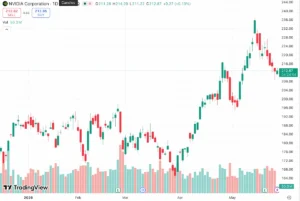
Technically, the setup is fragile. NVDA reached a new high of $236 last week ahead of earnings, then reversed sharply. The stock has slipped back to test its 20-day simple moving average — a level that held as support in early May. If that floor gives way, a pullback toward $200 becomes the likely next destination.
NVIDIA did authorize an additional $80 billion in share buybacks and raised its quarterly dividend to $0.25 per share, signaling confidence in long-term cash generation. But with shares already down roughly 9% from recent highs and sellers pressing, capital returns alone may not be enough to hold the line.
The fundamentals remain elite. The near-term risk, however, is real.