

Forex Trading Sessions: When the Market Never Sleeps
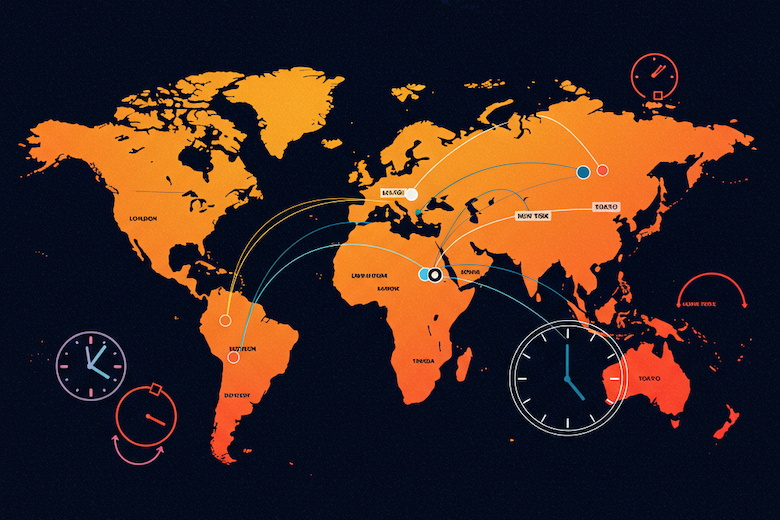
The Forex market is unique because it never sleeps. It operates 24 hours a day, five days a week. This schedule is continuous so that you can trade at any time that is convenient for you. However, just because you can trade at 2:00 AM does not mean you should. This round-the-clock action is broken down into trading sessions, each with its own personality, volatility patterns, and volume characteristics.
Foreign exchange trading is impossible to master without comprehending the global clock and its effect on market actions. Market trends during buy and sell periods. The market slows when the number of participants decreases.
This guide focuses on the main Forex trading sessions, how they overlap, and strategies for taking advantage of them based on the time of day.
Understanding Forex Market Hours
The Forex market is not a conventional actual exchange like the more familiar stock exchanges. It is a decentralized, over-the-counter market. This implies that the trading takes place electronically via a worldwide web of banks, brokers, funds, and individual retail traders.
One big financial capital shuts down at night, while another capital wakes up in the morning. Trade week begins with Asia-Pacific markets Sunday at 5:00 PM Eastern Time. It is always running until Friday at the New York market’s close at 5:00 PM Eastern Time for the weekend.
Retail trading does not happen on weekends. Price gaps can be created by events or news over the weekend when the market comes back on Monday.
Although the 24-hour environment is extremely flexible, liquidity fluctuates throughout the day. Liquidity is the ability to purchase or sell a currency without trading at an unusually large price. High liquidity means there are many active buyers and sellers.
This typically results in smaller spreads and order fulfillment with minimal slippage. The difference between the buy and sell price is called the spread, and the difference between your expected price and the price you actually get is called slippage.
Detailed Breakdown of the Four Major Forex Sessions
There are four main trading sessions in the world! The sessions follow the time zones of a major global city in typical working hours.
1. The Sydney Session
The Sydney session kicks off the trading week across the globe. It opens at 10:00 PM GMT and closes at 7:00 AM GMT. Because it represents the opening of the Asia-Pacific region on Monday morning local time, it sets the very first tone for the market after the weekend break.
This session is typically the smallest and quietest of the four major windows. The amount of volume dealt with is not high during these hours, as fewer numbers of huge banks are operating globally.
- Most Affected Currency Pairs: Most activity is concentrated on regional currency pairs. The Australian dollar and New Zealand dollar are the most traded currencies.
- AUD/USD: The daily range on this pair is 30 to 50 pips. A pip is the smallest increment a currency pair can go up or down by.
- NZD/USD: This cross is also quiet with a normal ranging of 30-50 pips.
- Market Drivers: Australian Bureau of Statistics economic data releases, or Reserve Bank of Australia monetary policy statements, move during these times.
Traders who like a peaceful environment will prefer the Sydney session. For anyone that is looking for a range of trading or does not prefer fluctuating prices, this low noise window provides a faded way to examine first tendencies.
2. The Tokyo Session
The Tokyo session is also known as the Asian session. It runs from 12:00 AM GMT to 9:00 AM GMT. Japan is a huge financial center, and this session provides especially extensive liquidity throughout the Asian continent, including traders from China, Hong Kong, and Singapore.
This is much more trading volume here than in the Sydney trading session and still less than in the more active trading areas of Europe and America. Many times price action can be a range-bound movement, which sees price bouncing between clear support and resistance without any strong or large breakout trends.
- Most Affected Currency Pairs: The Japanese Yen dominates this window. The cross-pairs that are connected with regional trade are also very active.
- MAJOR USD/JPY: This major is generally trading within 30-60 pips daily.
- EUR/JPY: This volatile cross-pair usually moves within a range of 40 to 80 pips.
- AUD/JPY: Australia and Japan are deeply interconnected. Therefore, this cross remains active and moves between 40-70 pips.
- Market Drivers: Economic indicators, imports and exports, and Bank of Japan policy statements in Japan are all important market drivers.
Traders who use ranges and clean tests can also find some good opportunities in Tokyo. Also, the activity rises in the last hour of this session when European institutions start preparing their orders.
3. The London Session
The London trading session is the beginning of trading in Europe. It is open from 8:00 AM GMT until 5:00 PM GMT. London is the actual hub of the foreign exchange market worldwide. As it is located in between the Asian and American time zones, massive institutional funds, commercial banks, and central banks conduct transactions through this window.
Liquidity and volatility increase greatly once London opens. The massive volume session will be spread very thin, and the cost of all transactions will come down. This setting presents a fertile area for traders trying to find substantial and definitive price actions.
- Most Affected Currency Pairs: Most importantly, almost every major pair reacts strongly to these hours, in particular pairs that are dependent on the euro, British pound, and Swiss franc.
- EUR/USD: It is the most traded pair all over the world, with a range of 50-90 pips at this time frame.
- GBP/USD: This pair is famous for its dynamic nature, often breaking 60 to 100 pips per day.
- USD/CHF: This consistent safe haven pair trades at a range of 40 to 80 pips.
- Market Drivers: Economic data out of the Eurozone, German industrial output data, and Bank of England interest rates are key drivers.
The London session is highly desirable for day traders and scalpers. Scalpers are those who enter and exit the market numerous times in a matter of minutes and try to profit from small price fluctuations. Because prices move fast and spreads are low, you can execute short-term strategies efficiently here.
4. The New York Session
The New York session represents the American market. It opens at 1:00 PM GMT and closes at 10:00 PM GMT. As the US dollar is involved in approximately 85% of all Forex trades, the New York session can affect the entire market.
The first few hours of this session are very fast-paced, as they are the same hours as the second half of the London session. There are huge orders from the institutions, and trading volume is enormous. European markets drone down a bit after they end their daily session but remain fairly active until the final bell.
Major Affected Currency Pairs: Any currency pair with the US dollar and Canadian dollar is the main focus.
- USD/CAD: This pair trades within 40 to 70 pips, as the United States and Canada are two neighboring countries with huge trading volume.
- EUR/USD: The heavy European participation pushes the range of this pair to 60 to 100 pips.
- GBP/USD: This cross enjoys a most volatile session that is moving by 70 to 110 pips at a time.
- Market Drivers: This session will be influenced by some high-impact economic data releases. It covers nonfarm payroll employment data, the consumer price index inflation data, and Federal Reserve official interest rates and monetary policy statements.
The New York time session is ideal for strong traders who enjoy the bustling atmosphere. Price action is high-pitched, and you can bank substantial profit if you take good risks.
Forex Session Hours in Standard GMT
| Session | Opens (GMT) | Closes (GMT) | Key Currency Pairs |
|---|---|---|---|
| Sydney | 10:00 PM | 7:00 AM | AUD/USD, NZD/USD, AUD/JPY |
| Tokyo | 12:00 AM | 9:00 AM | USD/JPY, EUR/JPY, AUD/JPY |
| London | 8:00 AM | 5:00 PM | EUR/USD, GBP/USD, USD/CHF |
| New York | 1:00 PM | 10:00 PM | EUR/USD, GBP/USD, USD/CAD |
The Power of Trading Session Overlaps
The most volatile times in the Forex trading market are the session overlaps. An overlap happens when two major financial centers are open for business at the same time. The times are windows where participants from one region are placing or closing trades while traders from another region enter a fresh set of trades.
This focused action generates significant trading volume. This translates to streamlined trading execution, reduced slippage, and the best spreads throughout the day for traders.
The London and New York Overlap (1:00 PM to 5:00 PM GMT)
This four-hour window is the most active and liquid part of the trading day. More than 50% of the entire daily Forex trading volume occurs right here. It brings together the large capital of Europe and the strong dollar volume of the U.S.
During these hours high-impact American data is released, which can cause the price to make enormous directional movements. This is the best time to scan for setups if you are seeking high volatility and a maximum level of liquidity.
The Tokyo and London Overlap (8:00 AM to 9:00 AM GMT)
The time duration of this brief window shows the changing market leadership from Asian to European. It is a lot shorter and less voluminous than the afternoon overlap, but extremely useful. It reveals to you whether the European traders are in accord with the price directions set by the Asia traders or whether they plan to reverse the trend. It’s a great time to trade big cross pairs like EUR/JPY.
The Sydney and Tokyo Overlap (12:00 AM to 7:00 AM GMT)
This extended overlapping accounts for the two main Asia-Pacific powers. While not as volatile as the Western sessions, it provides very secure liquidity for the AUD, NZD, and JPY. This is the ideal opportunity for early birds and conservative investors looking for steady price movement in the form of technical chart patterns, devoid of wild news-driven price action.
Session Overlap: When Things Heat Up
Session overlaps are often the best times to trade because of increased volume and volatility. The two most important overlaps are:
- London/New York Overlap: Typically between 8 AM and 12 PM EST. This is the most liquid time of day — ideal for day traders.
- Tokyo/London Overlap: Occurs in the early morning hours for Europe, but less volatile compared to the NY/London overlap.
Example: During the London/New York overlap, you might see major moves in EUR/USD or GBP/USD as both European and American banks participate in the market.
Session Characteristics at a Glance
| Session | Time (UTC) | Common Pairs | Volatility |
|---|---|---|---|
| Sydney | 10 PM – 7 AM | AUD/USD, NZD/USD | Low |
| Tokyo | 12 AM – 9 AM | USD/JPY, AUD/JPY | Moderate |
| London | 8 AM – 5 PM | EUR/USD, GBP/USD | High |
| New York | 1 PM – 10 PM | USD/CAD, USD/CHF | High |
Note: Exact times can shift due to daylight saving time changes in each region.
How Daylight Saving Time Changes the Clock
Traditional GMT is always the same, but the local time in worldwide financial centers varies all year because of changes in daylight saving time. This causes a short-term issue for traders worldwide.
The Northern and Southern Hemispheres have seasons alternately, so their clocks go in opposite directions depending on the time of year:
- In March, the U.S. and Europe advance clocks forward, while in October or November, the U.S. and Europe adjust clocks back.
- Australia will follow the opposite cycle, setting their clocks in April and October.
- Japan does not observe Daylight Saving Time at all, so Tokyo business hours never change.
Since these regions are not shifting precisely on the same dates, there is a temporary session overlap of 1 hour in March, April, October, and November. When a local market switches to DST before another local market, the session will appear as if it started one hour earlier based on GMT.
Global reference time conforms to local business time for local workers in New York, London & Sydney. These transition months, especially, require extra diligence in checking your trading platform clock to maximize that your trading strategies match up exactly with the additional inflow of market volume.
Aligning Your Strategy with the Right Session
Learning to be successful with your Forex trading needs matching your own trading style with the personality of the laid-back trading session.
Scalpers and Day Traders
If your strategies are based on fast trades, tight spreads, and volatile intraday price action, concentrate all your efforts on the London and New York sessions and the afternoon gap between these sessions. Trading during these hours may lead to unproductive trades where you lose less than you would like to on your small targets.
Swing Traders and Long-Term Investors
The precise time you enter a trade is not so critical if you are holding for days or weeks. Swing traders have an eye for daily chart patterns and macroeconomic data. If you’re of this persuasion, you may want to study the charts during the Sydney or Tokyo session when less of the world is awake to avoid ordering trades amidst the euphoric frenzy of the London and New York markets.
Currency Pair Selection
Always trade in currencies of active financial centers. If you want to trade the Australian dollar, do it during the Sydney and Tokyo hours. Wait for the London open if you are looking to trade the euro or the British pound. This means you’ll never be caught with limited volume for support and resistance.
Using Sessions in Demo Trading
Practicing with session-based strategies in a demo account can be a valuable learning tool. Here are a few ideas:
- Trade breakouts during the London open.
- Test range trading during the quieter Sydney session.
- Use the London/New York overlap for high-volatility momentum strategies.
Pro Tip: Many brokers offer tools or indicators that visually show which session is currently active on your trading platform.
When NOT to Trade
There are certain times when liquidity and price movement are minimal:
- Late Friday afternoon — traders begin closing positions before the weekend.
- Holidays — markets may be technically open but lack movement.
- Between sessions — known as the “dead zone” (e.g., between New York close and Sydney open).
In demo environments, even these “slow times” can be used to observe market behavior or practice placing limit/stop orders for when things pick up again.
Conclusion
Understanding Forex trading sessions helps traders choose the best times to engage the market. Each session offers different opportunities based on liquidity, volatility, and time zone dynamics. Even if you’re trading on a demo account, building the habit of timing your trades around sessions can lead to better decision-making in live conditions.
The market may never sleep, but that doesn’t mean you should trade every hour of the day. Timing is everything in Forex.
FAQs
What are the exact retail Forex market hours?
The retail trading market is open from Sunday 5:00 PM ET to Friday 5:00 PM ET, and the institutional interbank market is open 24 hours a day.
Can I leave my trades open over the weekend?
Yes, you can leave trades open, but it comes with significant risk. The market can open Monday at an entirely different price if major economic news occurs over the weekend. This can cause a price difference that can avoid your protective stop loss, resulting in bigger losses than intended.
Which trading session is the most profitable?
There is no single session that will be more profitable than another. The overlap has the biggest volume and largest price swings, though, and therefore gives the greatest return on trend and breakout trades to investors using this time frame.
Why do spreads widen at 10:00 PM GMT?
This time is the New York close and the opening of the Sydney session. Because major global banks are handing over their operations, overall trading volume drops to its lowest daily level. During this short period, the broker spread increases to guard them against the lack of liquidity.
Does Japan use daylight saving time?
Nope, Japan does not change its clocks. The Tokyo session always opens at 12:00 AM GMT and closes at 9:00 AM GMT all year round.
Disclaimer: This article is for informational and demonstration purposes only. Always consult with a financial advisor before engaging in live trading.